
New Synthetic Blood May Help Save Lives
Did you know that blood accounts for about 7 to 8 percent of your total body weight? While you’ve probably never given much thought to the blood in your body, it really is a fascinating fluid!
Blood has many different functions in the body, including transporting oxygen to your lungs, carrying cells and antibodies to fight infection, regulating body temperature, and forming blood clots to stop bleeding. It is a specialized body fluid that is made up of four main components: plasma, red blood cells, white blood cells and platelets. Because of how essential blood is in our bodies, scientists have spent years attempting to re-create parts of human blood that can be used in emergency situations.
So why is all of this necessary? Because whole blood can only be kept for a few weeks, and it requires refrigeration. There are times when that’s simply not possible, such as on a navy ship that’s at sea for months at a time or when soldiers are at war in another country and not able to have regular medical supply deliveries.
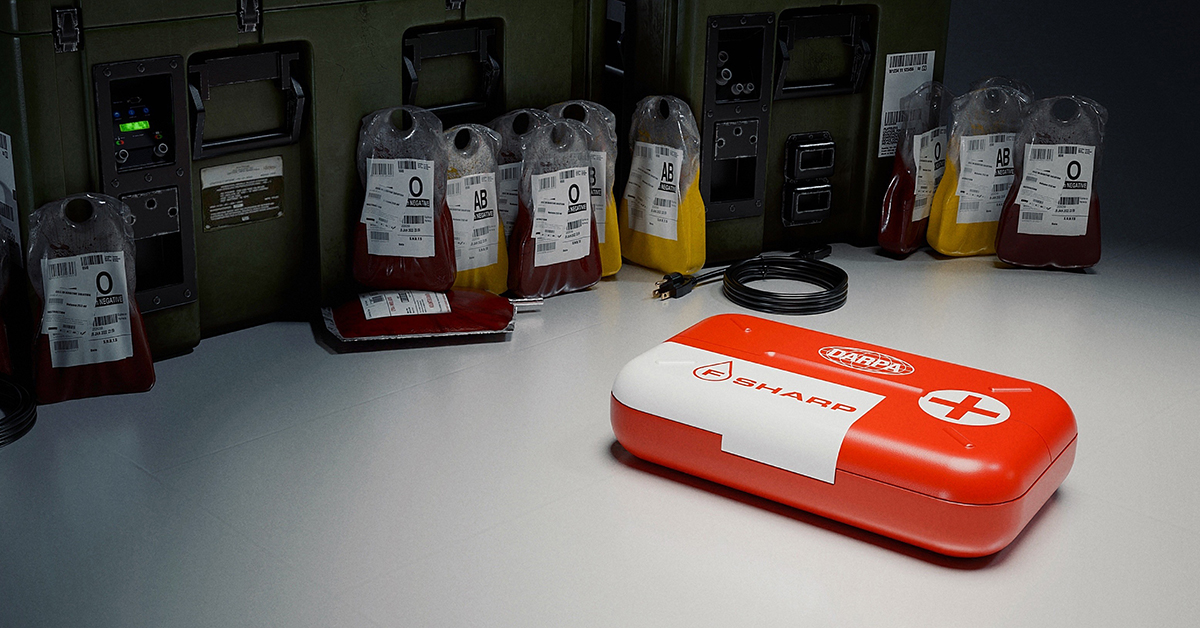
That’s why DARPA, the Defense Advanced Research Projects Agency, is working on a program known as Fieldable Solutions for Hemorrhage with bio-Artificial Resuscitation Products (FSHARP) to develop biosynthetic blood components to safely and effectively provide the functions of whole blood.
According to Lt. Cmdr. Robert Murray of DARPA, the FSHARP program has been able to deliver freeze-dried plasma, synthetic red blood cells, and synthetic platelet particles. These components are shelf stable, meaning they don’t require refrigeration, and have a much longer shelf life than whole blood. For example, the freeze-dried plasma is good for up to two years. This means that soldiers would be able to carry supplies with them in the event of injuries, and would not have to rely on regular deliveries of refrigerated, whole blood.
The ultimate goal is to deliver a fully approved, easily transportable system that can save lives at the point of injury as early as 2029.