Wildfires in Canada Ignite Health Issues
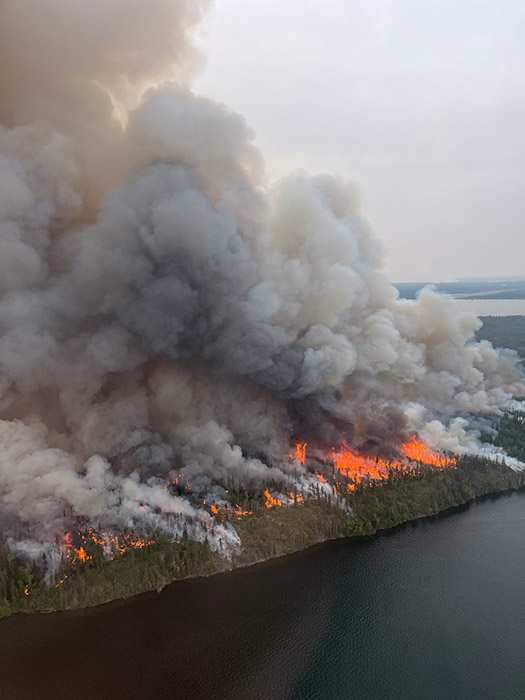
Thunderhill Lake Complex, Manitoba, Canada.
Image: US government
In July, more than 100 million Americans across 14 states were impacted by heavy smoke and air quality alerts from Canadian wildfires.
Scientists track air quality with the air quality index, or AQI, which incorporates different pollution contributors, such as ozone and fine particulates. The AQI includes six color-coded categories. For example, values between 0 to 50 are labeled as satisfactory with the color green to reflect that air pollution poses little to no risk. The higher the AQI value, the greater the level of air pollution and the greater the health concern.
With the recent wildfires, several U.S. cities reached AQI scores of more than 500. One of the reasons that concerns scientists is that exposure to wildfire smoke is a growing health problem across the country. The smoky air is not healthy for anyone, but it can prove particularly challenging for those with respiratory issues, such as asthma.
More than 900 individual wildfires were responsible for the southern-moving smoke. Many of those fires were burning in Canada’s boreal forests.
Boreal forests, also known as Taiga, circle the Northern Hemisphere, forming a ring around the North Pole. The forests store carbon, purify air and water, and help regulate the climate. Canada is home to more than a quarter of the world’s boreal forests. For comparison, Canada’s boreal forest is roughly 220 times the size of Yellowstone National Park.
Major forest fires have become a regular occurrence in Canada. Climate experts say rising temperatures have led to drier timber, which leads to an increased fire risk. Accelerating climate change also makes wildfires more destructive as they burn bigger and hotter. Data shows Canada is warming twice as fast as the global average. When you consider how much of the boreal forest is in Canada, the math starts to make sense about why forest fires are becoming more common and more destructive. Canada’s last three fire seasons have been among the 10 worst since 1972, with the most destructive wildfire season recorded in 2023.