
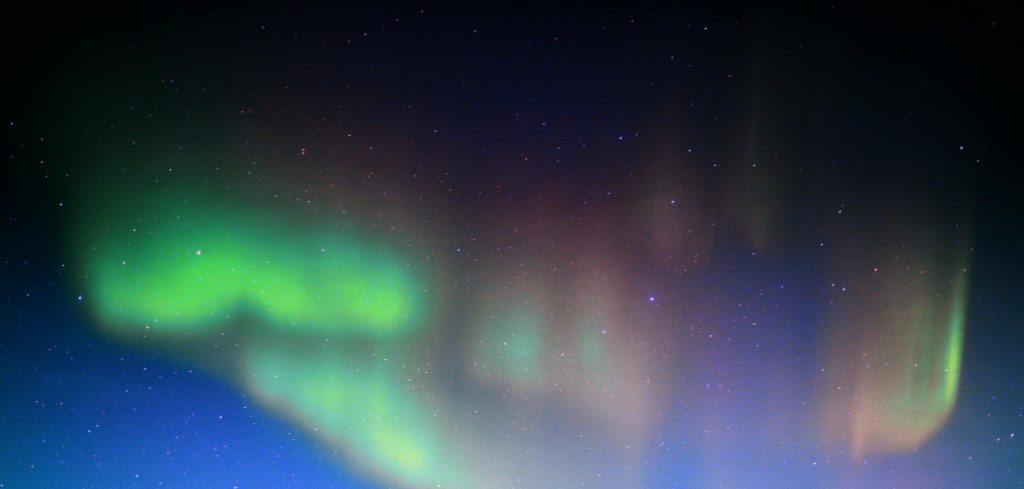
On Nov. 11, southern Arizona residents witnessed faint pink and purple hues appear on the northern horizon. Viewers posted photos from places such as far south as Tucson, Mount Lemmon, Tanque Verde and
Safford.
The lights were visible thanks to Arizona’s geomagnetic storm. According to experts, the northern lights are caused by the solar wind, or a stream of charged particles emitted by the sun. The sun’s magnetic field gets disrupted in 11-year cycles, and phenomena like sunspots, flares, and mass ejections occur. Plasma is released and interacts with the Earth’s atmosphere.
Normally, charged particles interact with the Earth’s atmosphere most at the poles, or
high-latitude regions. Occasionally, Aurora Borealis, another name for the northern lights, can be seen in lower latitude regions such as Arizona recently due to strong solar storms, ranked G1 to G5, allowing solar winds to interact with gases in the Earth’s upper atmosphere. These atmospheric gases excite and release energy in the form of colorful lights.
In November, the geomagnetic storm that allowed Arizona to experience the northern lights was a G4 level storm, caused by coronal mass ejections (CMEs), or a large burst of plasma and magnetic fields that has the capability to interact with Earth’s magnetic field. The best show can be seen in areas far from city lights, where light pollution cannot interfere as much. Behind the magnificent view lies a complex scientific phenomenon that produces the pink, green, and purple hues we can see in the night sky from our backyards.